Financial data is often delivered in XBRL, a common standard for exchanging business information and ensuring reporting transparency. Although XBRL is optimized for machines, it is difficult for people to read or share in polished documents. Many businesses and individuals therefore need a reliable XBRL‑to‑PDF conversion method. PDF files are universally recognized, easy to distribute, and keep financial data intact. An online XBRL to PDF converter lets you instantly create clean, professional PDFs without installing software.
Why Convert XBRL to PDF Online?
There are several reasons why converting XBRL into PDF can be beneficial for both individuals and organizations:
Better readability: While XBRL is structured for systems, PDF makes it easier for humans to read and interpret financial statements.
Universal compatibility: PDF can be opened on virtually any device without needing specialized tools.
Professional presentation: PDF offers a clean and polished format suitable for official reports and business communication.
Ease of sharing: PDF documents are lightweight, easy to email, and convenient to archive.
Data integrity: Conversion ensures that the structure and details of the original financial information remain preserved.
Free Online XBRL to PDF Converter
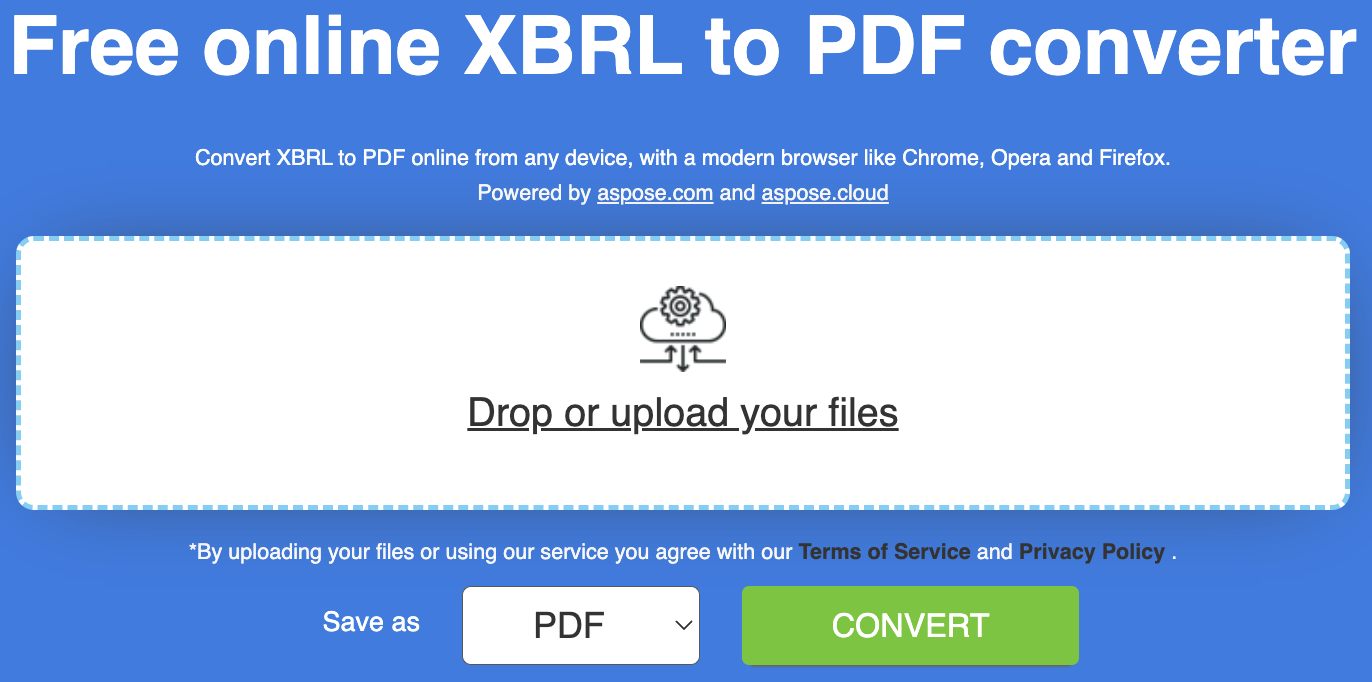
The online XBRL to PDF application lets you upload an XBRL file and download a PDF in a few easy steps. Conversion runs securely in the browser, eliminating complex setup and keeping your data safe. Developers can use Conholdate.Total for .NET or Java SDKs for advanced, programmatic XBRL‑to‑PDF integration.
Developer’s Guide to Convert XBRL Files
For developers who want to integrate XBRL to PDF conversion into their own applications, Conholdate.Total for .NET SDK provides powerful features that make the process seamless. Below is an example demonstrating how to convert an XBRL document to PDF using C#.
Convert XBRL to PDF using C#
The sample code below converts XBRL to PDF in C#:
 // Load XBRL document
 XbrlDocument document = new XbrlDocument(sourceDir + @"sample.xbrl");

 // Set save options
 Aspose.Finance.Xbrl.SaveOptions saveOptions = new Aspose.Finance.Xbrl.SaveOptions();
 saveOptions.SaveFormat = Aspose.Finance.Xbrl.SaveFormat.XLSX;

 // Save XBRL as XLSX in File Stream
 FileStream fs = new FileStream("sample_out.xlsx", FileMode.Create);
 document.Save(fs, saveOptions);

 // Open an Excel file
 Workbook workbook = new Workbook(fs);

 // Save the document in PDF format
 workbook.Save(outputDir + "sample_output.pdf", Aspose.Cells.SaveFormat.Pdf);
This snippet first loads the XBRL document and converts it into an XLSX file which is then opened in Excel format. Finally, the Excel file is exported as a PDF document. Using Conholdate.Total for .NET SDK, you can easily automate this process for bulk files or integrate it within financial reporting systems.
Conclusion
Converting XBRL to PDF helps organizations make financial data more accessible, shareable, and professionally presented. The online converter offers a quick, secure solution without installation, while developers can use Conholdate.Total .NET or Java SDKs to embed conversion into enterprise applications. This streamlines workflows, supports compliance, and enhances internal and external communication of financial information.